

The Question
A spectre is haunting the world: the spectre of Artificial General Intelligence (AGI). This sentence might describe our current global situation: a world that is trying to overcome humanity with “a better” intelligence machine, developing a scarecrow of our time. Is such an achievement even possible? To answer this question, we must investigate a different but related question: how did we arrive here? The best way to answer is by understanding our present and focusing on its features.
The Hyperstorical Society
In our epoch lies a uniqueness and a peculiarity: whether the flow of time may be divided into periods, we are at the beginning of a new era, as Floridi says:
“[…] In prehistory, there are no ICTs; in history, there are ICTs, they record and transmit information, but human societies depend mainly on other kinds of technologies concerning primary resources and energy; and in hyperhistory, there are ICTs, they record, transmit, and, above all, process information, increasingly autonomously and human societies become vitally dependent on them and on information as a fundamental resource in order to flourish.”[1]
We live in a society in which data are the essential condition for its maintenance and its development, for the more the amount of GDP of a country depends on these intangible goods, the more it relies on them and hence their number could only increase. Our everyday life is based on data, we produce data, we live by data.[2] This is the core of hyperhistory: to guarantee it, every second an enormous number of ICT (Information and Communication Technology) devices produce vast quantities of data. Furthermore, this production and consumption of data leads us into the age of the zettabyte:
“A few years ago, researchers at Berkeley’s School of Information estimated that humanity had accumulated approximately 12 exabytes of data in the course of its entire history until the commodification of computers, but that it had already reached 180 exabytes by 2006. According to a more recent study, the total grew to over 1600 exabytes between 2006 and 2011, thus passing the zettabyte (1000 exabytes) barrier. This figure is expected to grow fourfold approximately every three years, so that we shall have 8 zettabytes of data by 2015”.[3]
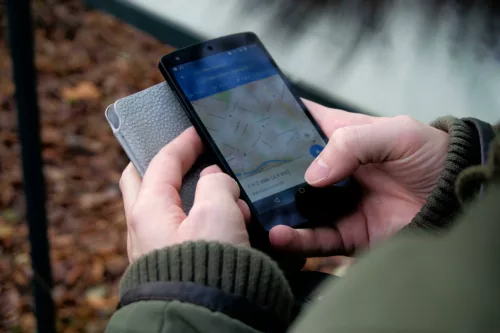
Consider our daily life: if you need to go to a place, you will use Google maps. Not only is it giving you directions, but also it adapts in real time to traffic, weather, and your unique behaviour. Such an instance highlights how humans increasingly depend on ICTs even to navigate the most basic activities: everything has been “datified.”
The Information Revolution
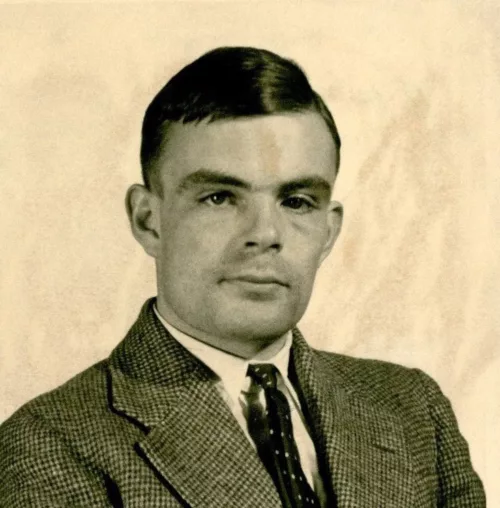
This incredible amount of data offers us a unique environment to live in, called infosphere, because of the information revolution that started by Turing. In his work, we have been displaced from our logical superiority position: digital devices could supply more tasks in a faster way than we can.
Turing posed a famous question:
“I propose to consider the question, ‘Can machines think?’, this should begin with definitions of the meaning of the terms ‘machine’ and ‘think.’ […] The original question ‘Can machine think?’ I believe to be too meaningless to deserve discussion.”[4]
The challenge concerned the difficulty of defining those two terms, as it is for us today: there are so many definitions of intelligence and of machine that it might be impossible to spot any analogies between them.[5] Thus, neither the machine nor we could be considered superior to the other: without a shared standard, it is only a matter of ability to read information and data. At this level, the machine, or, as we call it, the artificial intelligence (AI), outperforms us, bypassing reasoning while achieving the same result.
Turing’s Experiment
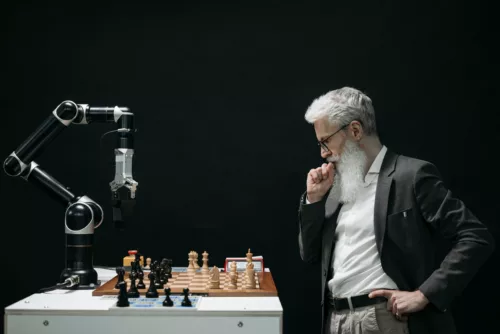
Even in Turing’s experiment, the aim was not to understand if that machine might be intelligent but to show that it might perform in an indistinguishable way from human behaviour. Let us consider it in a more specific way:
“The players are three people, a man (A), a woman (B) and an interrogator (C), who can be of one or the other sex. The questioner is in a separate room from the other two. For the interrogator, the object of the game consists in determining which of the other two players are the man and which is the woman; he knows them as X and Y, and at the end of the game he will say “X is A and Y is B” or “X is B and Y is A”. The questioner may ask questions […]. For A, the aim of the game is to try to make C misidentify himself. […] Now let’s ask ourselves: “What will happen when, in this game, it is a machine that plays the part of A?” when the game is played, will the questioner make the wrong decision as often as he does when the game involves a man and a woman?”[6]
The whole experiment is defined in terms of outcomes: the machine must trick the interrogator to be considered as a human, based on its behaviour. Along the same lines, the fathers of the discipline have defined AI as « […] a machine [that] behave[s] in ways that would be called intelligent if a human were so behaving», underlining a unique new horizon for the role of agency. Thus, the information revolution has changed the way we see and interact in the world.
The Agency Change
In our hyperstorical society, we witness a coupling and decoupling of world features we used to understand as unchangeable. We are undergoing a period of re-ontologization in which the foundations of reality are being transformed:
“[…] The digital is not merely enhancing or augmenting reality. It radically transforms reality because it creates new environments that we then inhabit, and new forms of agency with which we then interact. In the past, I used the expression re-ontologizing to refer to a very radical kind of re-engineering. This sort of re-engineering not only designs, constructs, or structures a system anew but fundamentally transforms the intrinsic nature of the system itself – that is, its ontology. […] And by re-ontologizing modernity, to put it shortly, the digital is re-epistemologizing modern mentality as well”.[7]
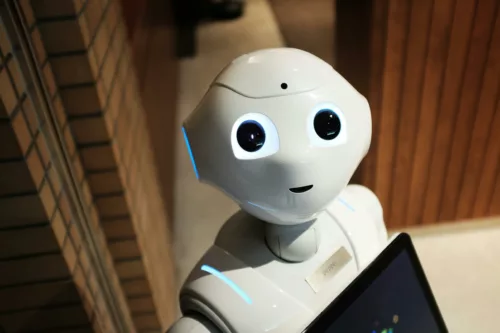
The problem does not lie at this level. That is merely a question of engineering, but in our effort to understand these changes, concerning the level of re-epistemologization, i.e. the new role of agency. Indeed, by this term we refer to a system based on three conditions[8]:
- a. The capacity to receive and use data from the environment.
- b. The ability to act upon input for achieving a goal autonomously.
- c. The potential to improve performance, underlining the importance of interactions.
To better understand this, just consider the social media algorithms: through them, the user becomes less of an agent and more of a “subject shaped”. Even if he thinks to be in control, he turns out to be the product of an AI that cannot understand what it is doing but it does. Hence, next time you doomscroll on TikTok, think about this.
An Intelligence not Intelligent
Within this framework, we can now comprehend the AI definition: a tool that reproduces human behaviour and outcomes, but without any human intelligence. It is a decoupling between the requested effort to reach something, and its corresponding “obtaining”. Thus, we do not have any real intelligent machine, but only an optimization offered by the enormous amount of data available today. As Floridi observes:
“In AI, the outcome matters, not whether the agent or its behaviour is intelligent. Thus, AI is not about reproducing any kind of biological intelligence. It is about doing it without it. Current machines have the intelligence of a toaster, and we really do not have much of a clue about how to move from there. […] In short, it is precisely when we stop trying to produce human intelligence that we can successfully replace it in an increasing number of tasks”.[9]
Think about an LLM (Large Language Model) like ChatGPT: these tools generate human-like responses but have no understanding of what they write. Thus, despite lacking awareness, they may be able to draft essays. Yet AI has registered a remarkable success. How is it even possible? We need to consider the topic from another point of view, because the answer lies in the environment.

The AI Enveloping World
Humans have created a specific environment where ICTs are at home, and so is AI. In fact, these technologies are increasingly inscribing our world, thanks to its interpretations in terms of mathematical layers optimized for computation:
“In the 1940s and 1950s, the computer was a room and Alice used to walk inside it to work with it. Programming meant using a screwdriver. Human-computer interaction was a somatic relation. In the 1970s, Alice’s daughter walked out of the computer, to step in front of it. Human-computer interaction became a semantic relation, later facilitated by DOS (Disk Operating System) and lines of text, GUI (Graphic User Interface) and icons. Today, Alice’s granddaughter has walked inside the computer again, in the form of a whole infosphere that surrounds her, often imperceptibly. Human-computer interaction has become somatic again, with touch screens, voice commands, listening devices, gesture-sensitive applications, proxy data for location, and so forth”.[10]
If we have a digital world, its inhabitants are suitable for it, and, if that world has been built by someone else to guarantee its best effort, then we have a perfect world adapted for those inhabitants. Therefore, humans have begun to envelop their own into AI, optimizing everything for it. AI does not need to understand the world, but it only exploits its data, bypassing questions of meaning, relevance, truth, to succeed in its tasks. In this way, every problem might be solved: no more fatigue but only more speed to put an end to everything.
The Adaptation Problem
Anyway, this heaven conceals serious risks: humans might become part of that mechanism as new means of digital production. AI needs a semantic engine to work correctly and hence humans cannot do anything but feed it, trying to convert the world experience into a limited number of suitable data. The key question becomes: who is adapting to whom? As we shape our world to fit AI, we risk reshaping ourselves. We may either guide this modern technology in a human direction, or be overwhelmed by it, but both results depend on our skills to design this new environment. Floridi urges:
“By becoming more critically aware of the re-ontologizing power of AI and smart applications, we might be able to avoid the worst forms of distortion or at least be consciously tolerant to them. […] Human intelligent design should play a significant role in shaping our future interactions with current and forthcoming smart artefacts and our shared environments. After all, it is a sign of intelligence to make stupidity work for you.” [11]
We are not in the exploration or in the innovation era, but in the era of design: we have a responsibility to make the best use of these innovative technologies to continue to be at the centre and not pushed to the edges. Now, we can return to the original question we have put at the beginning: what is the AGI?
The Scarecrow
AGI is not a super-intelligence machine, but a reflection of what we are sacrificing in pursuit of technological productivity. Those who endorse this vision are the ones who pretend to be saviours of humanity: because AGI is the real so-called “future challenge of humankind”, we need to sacrifice our present to have a better future. Otherwise, such a view could be seen as an alienation from the real danger, not linked to our future but to our present: although AGI may be underlining an urgent problem, it may distract us from workable solutions. Leave to the future what is for the future and focus on the present: it is the only way to avoid that scarecrow and, only then, build a better tomorrow. The scarecrow of AGI is made of straw: it does not stand for what we face but for what we refuse to see. Thus, we must see behind it.
Humanity’s Space
If on one side there is the world adapted to AI, on the other side we have the world built by humans: a world that relies on public reasons and, hence, a shared one for everyone who needs to understand their surroundings. While AI bypasses reasoning, humans rely on it, as it has long been known by humankind: Aristotle, in the IV century BC, spoke about it in terms of phronesis, the act of judging after a consideration of other opinions and the aspects of a particular situation. Thus, it is not delegable to someone else, or bypassed with a universal rule, but only the subject living those circumstances can face it. It is the virtue that unifies and refines all the others, like a super-virtue that calibrates our attitude.
This space of moral reasons, inhabited by us, could be understood in two ways, as Vallor writes:
“It is on the private mental space where you enjoy the psychological freedom to reflect upon morally salient facts, values, possibilities, principles, consequences, and ideals that might inform and guide your own actions. It is the space you occupy whenever you are faced with a difficult moral dilemma in your life and have to examine the reasons for choosing one actions over another. But it can also be a public space where morally salient facts, values, possibilities, principles, consequences, ideals, etc., are entered into a shared moral dialogue”.[12]
It is something we need to defend to be, and to stay, human: indeed, if we yielded this to something else, like an AI, we would be expelled from humanity. But this is what is currently happening: we allow technology to have free rein and, because we delegate our decision-making to it, it will take us over. The enveloping world is a clever idea, but we must also consider our moral space as something not to retreat from, otherwise we might face problems linked to efficiency. Consider ethical choices made by AI in autonomous vehicles: how does it has to react? The answer may not be found in efficiency, but only in moral reasoning.
The Mirror
To use a metaphor for a better understanding, Romans used to personify prudentia, and so the Latin translation of phronesis, with a mirror in her hand and a second face looking backward: practical wisdom needs a clear sight of everything, like a mirror, but also needs to learn from past experiences. That is a great difference from AI: they both could be considered as mirrors, but while the former, prudentia, offers occasions to modify our attitude, the latter, AI, only reproduces what was the past, without any change, and cast it into the future. Indeed, in an enveloped world, there is no place for novelty and openness because everything is optimized to have the best effort. AI works only by relying on a limited amount of data, and this is a reason of why it cannot surpass humanity: if the world experience is unlimited with unique details and paths, these cannot be converted into a fixed amount once and for all. So, by contrast, phronesis has something more:
“Prudence uses her mirror to walk more wisely forward. If we mindlessly replicate what we see in the mirror of history, we will never build upon that knowledge, never free to try new and better approaches”.[13]
The occupation of moral space
We stated that moral space has a superiority against the enveloped world, but the latter might easily occupy the former, and when it happens, we cannot give reasons for that decision. For AI, only maximum optimization is what is necessary, without any further considerations. This is linked not to anything other than the values that our current society delivers to us: technology always brings with it these crystallized values. Whether our current society is based on productivity, so is AI: if you are not able to be the best and produce more, then you could be sacrificed for a better one, or, in this case, for a better tool.
Here lies the fear of AGI: not a real danger given from the evolution of AI, but from the de-evolution of humanity. It is the fear of losing who we are to have a more productive society where everything is sacrificed for it:
“Remember: the danger to our humanity from AI is not really coming from AI itself. The call is coming from inside the house: AI can devalue our humanity only because we already devalued it ourselves. Indeed, one very common response to the cultural shock of generative AI tools has been not to admit the discontinuity between humans and predictive machines, nor even to pretend that AI tools have their own inner unspoken depths, but rather to deny that humans do”.[14]
The method on which AI is based is unforeseeable for us: we can know only what data we put into it, but the result cannot be predicted from a human being. That said, we cannot explain the reasons behind such decisions, only knowing that the answer is the best one in terms of efficiency. In this way, we lose our humanity, and hence we lose our direction to the future, by imagining an escape from this situation only through migration to another planet. As Elon Musk has said, the earth is doomed, and we need to pack our bags. But this covers the real problem, as Robinson writes:
“If we were to create a sustainable civilisation here on Earth, with all Earth’s creatures prospering, then and only then would Mars become even the slightest bit interesting to us […] until we have solved our problems here, Mars is just a distraction for a few escapists, and so worse and useless”.[15]
Building this sustainable civilization requires pointing out where the mistake lies: the first step for the cure is the diagnosis. We need to unfold our past and discover it.
The Greek Sin
Returning to the BC era, aside from phronesis, we find that mistake. Indeed, the Greeks used to ignore the role of “mechanical arts” and, so, of technology, because it was associated with skills of women and the domestic sphere, far from the good political life dedicated solely to thought. I.e. Plato wrote that “no citizen of our land nor any of his servants should enter the ranks of the workers whose vocation lies in the arts or crafts”[16] underlying this divorce between free man and servants. However, this mentality signed a gap between morality and technology: without a clear cultural vision, the latter leads us into an almost dystopian society where there is no human project adapted to our times:
“The present orientation and configuration of our AI mirrors, and the purposes for which we build them, only tighten our grip on the instruments of our ruins. […] we strangle in the garments we have woven”.[17]
Could it be time for a new technological culture? It’s not so late to do it. The concern is not AI in general, but the correct use of it: we must find a new way and take another direction, building a shining future not haunted by the AGI spirit.
The Pretechnical
Ortega y Gasset, decades ago, wrote:
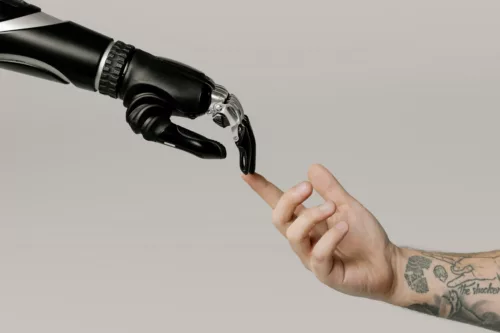
“Technology is, strictly speaking, not the beginning of things. It will mobilize its ingenuity and perform the task life is; it will – within certain limits, of course – succeed in realizing the human project. But it does not draw up that project; the final aims it has to pursue come from elsewhere. The vital program is pretechnical”.[18]
He pointed out that at the level of technology there is not a project but it lies behind its embedment into instruments that we are used to. So: What lies behind the technic? Something that AI cannot reflect because it may not be defined in terms of data, the starting point from which phronesis is derived but we are getting rid of. For this purpose, Aristotle returns to help us again: such conditions are set up in human nature. Indeed, the philosopher stated human is a social being, the famous zoon politikon, because he is naturally linked to the others and, hence, he needs the others to remain who he is. Despite nature made us fragile, vulnerable and without any chance to survive on our own, it also guarantees us to stay together and, thus, become stronger:
“The human beings are vulnerable as a condition of our nature of being people. […] It’s an anthropologic characteristic that defines us. Otherwise, we tend to hide it. The pandemic put us in a condition to remember our vulnerability in a tough way”.[19]
This is the pretechnical ground: our physical, fleshy world that links us not only to each other but also, obviously, to our planet. We cannot be a part of nature without considering the significant role of whole nature because our vulnerable features come from it. Since we are vulnerable things, in a vulnerable world, our future must be guided by the cure, as the deepest living reality:
“The dynamics by which man is able to take care of himself and the world, taking care of others and creating a semantically relevant culture of relationship, therefore highlight a principle of unitary integration that gives historicity to the combined evolution of these three dynamics, which can never be separated from each other”.[20]
The Cure Program
The cure program offers a future in which every human being may develop themselves in the best feasible way, thanks to the reciprocal caring with a general ‘others’, including other individuals as well as the whole of nature. Between this cure and this future, phronesis finds its domain: starting from our current situation, we need to assess the best possible actions to have the best possible outcomes for our future to guarantee the best cure for everyone. Into this project, AI could have a significant role:
“There’s time to come together in a state of emergency and remember that we are our own Kubernetes – pilots or “those who steer” in Greek, and in the cybernetic theory of Norman Wiener that influenced the birth of AI research. Steering ourselves doesn’t mean turning our back on technology. It means reclaiming technology as a human-wielded instrument of care, responsibility, and service”.[21]
The basis for this change is under the eyes of everyone: where there is a difficulty, a suffering, or a danger, we need to take care of it. We must reconnect our human values with technology: Plato made an error, our future depends on our capacity to correct it. A good example might be AI Act made by EU; indeed, it embodies the spirit of a modern design setting up a structure of human values for AI. Rather than passively adapting to AI, the EU actively shaped the technological environment according to shared moral reasoning, against the scarecrow of AGI. This is a concrete instance of the cure program, as an attempt to anchor technology within the horizon of human flourishing.
Toward a Better Future
AGI is not a true threat, but a projection of our own disconnection from human values. The real danger lies in designing a world optimized for machines, where human judgment, moral reasoning, and vulnerability are sidelined in favour of efficiency. Rather than fearing a hypothetical superintelligence, we should fear our own willingness to sacrifice phronesis—practical wisdom—for convenience and control. To build a meaningful future, we must reclaim our role as designers, anchoring technology in human needs, social bonds, and ethical reflection. As Ortega y Gasset wrote, technology follows a project—it does not create it. That project must come from us. If we want to avoid being ruled by the scarecrow of AGI, we must return to what makes us human and steer technology accordingly. Wiener’s words might be considered as a warning:
“[…] The machine that can learn and can make decisions based on this acquired knowledge will in no way be obliged to decide in the same way as we would have decided ourselves, or at least in a way that is acceptable to us. For those who are not aware of this, placing the problem of their responsibility on the machine will mean entrusting their responsibility to the wind and seeing it come back in the whirlwinds of the storm”.[22]
Ultimately, we can sum up everything with only a sentence: the experience may be datifiable, but it is not datified. We have a responsibility to steer this technology toward a better future.
Bibliography
- Bertolaso, M., Marcos, A., Umanesimo tecnologico. Una riflessione filosofica sull’intelligenza artificiale, Carrocci editore, Roma 2023.
- Feito, L., La vulnerabilidad ante la pandemia, in “Bioètica Complutense”, 39, 2020.
- Floridi, L., The Ethics of Artificial Intelligence, Oxford University Press, Oxford 2023.
- Floridi, L., The Fourth Revolution. How the Infosphere is Reshaping Human Reality, Oxford University Press, Oxford 2014.
- Ortega y Gasset, J., “Man the Technician”, History as a System, and Other Essays Toward a Philosophy of History, Norton and Company, New York 1961.
- Plato, Laws, 846d.
- Turing, A., Macchine calcolatrici e intelligenza, Giulio Einaudi Editore s.p.a., Torino 2025.
- Vallor, S., The AI Mirror. How to Reclaim Our Humanity in an Age of Machine Thinking, Oxford University Press, Oxford 2024.
- Wiener, N., Introduzione alla cibernetica. L’uso umano degli esseri umani, Bollati Boringhieri, Torino 2012.
Online sources
Robinson, K. S., “Mars is irrelevant to us now: we should of course concentrate on maintaining the Habitability of the Earth”, interview by K. Mogensen, Farsight, August 10, 2022, Copenhagen Institute for Futures Studies (https://farsight.cifs.dk/interview-kim-stanley-robinson/).
Footnotes
[1] L. Floridi, The Fourth Revolution. How the Infosphere is Reshaping Human Reality, Oxford University Press, Oxford 2014, p. 6.
[2] Data, also known as Big Data, are the quantities, characters, or symbols on which operations are performed by a computer and may be stored and transmitted in the form of electrical signals and recorded on recording media.
[3] Ivi, pp. 12-13.
[4] A. Turing, Macchine calcolatrici e intelligenza, Giulio Einaudi Editore s.p.a., Torino 2025, p. 8.
[5] There are at least 8 different type of intelligence and 5 of machine.
[6] A. Turing, Macchine calcolatrici e Intelligenza, cit., pp. 8-9.
[7] L. Floridi, The Ethics of Artificial Intelligence, Oxford University Press, Oxford 2023, p. 9.
[8] Ivi, p. 10.
[9] Ivi, p. 23. The question concerning what intelligence is very wide and abstruse to point out in this article. Floridi reports this in its work, cfr. pp. 14-22.
[10]L. Floridi, The Fourth Revolution. How the Infosphere is Reshaping Human Reality, cit., p. 144.
[11] L. Floridi, The Ethics of Artificial Intelligence, cit., p. 30.
[12] S. Vallor, The AI Mirror. How to Reclaim Our Humanity in an Age of Machine Thinking, Oxford University Press, Oxford 2024, p. 108.
[13] Ivi, p. 101.
[14] Ivi, p. 150.
[15] K. S., Robinson, “Mars is irrelevant to us now: we should of course concentrate on maintaining the Habitability of the Earth”, interview by K. Mogensen, Farsight, August 10, 2022, Copenhagen Institute for Futures Studies (https://farsight.cifs.dk/interview-kim-stanley-robinson/).
[16] Plato, Laws, 846d.
[17] S. Vallor, The AI Mirror. How to Reclaim Our Humanity in an Age of Machine Thinking, cit., p. 191.
[18] J. Ortega y Gasset, “Man the Technician”, History as a System, and Other Essay Toward a Philosophy of History, Norton and Company, New York 1961, p. 119.
[19] L. Feito, La vulnerabilidad ante la pandemia, in “Bioètica Complutense”, 39, 2020, p. 2.
[20] M. Bertolaso, A. Marcos, Umanesimo tecnologico. Una riflessione filosofica sull’intelligenza artificiale, Carrocci editore, Roma 2023, p. 88.
[21] S. Vallor, The AI Mirror. How to Reclaim Our Humanity in an Age of Machine Thinking, cit., p. 216.
[22] N. Wiener, Introduzione alla cibernetica. L’uso umano degli esseri umani, Bollati Boringhieri, Torino 2012, pp. 228-229.